
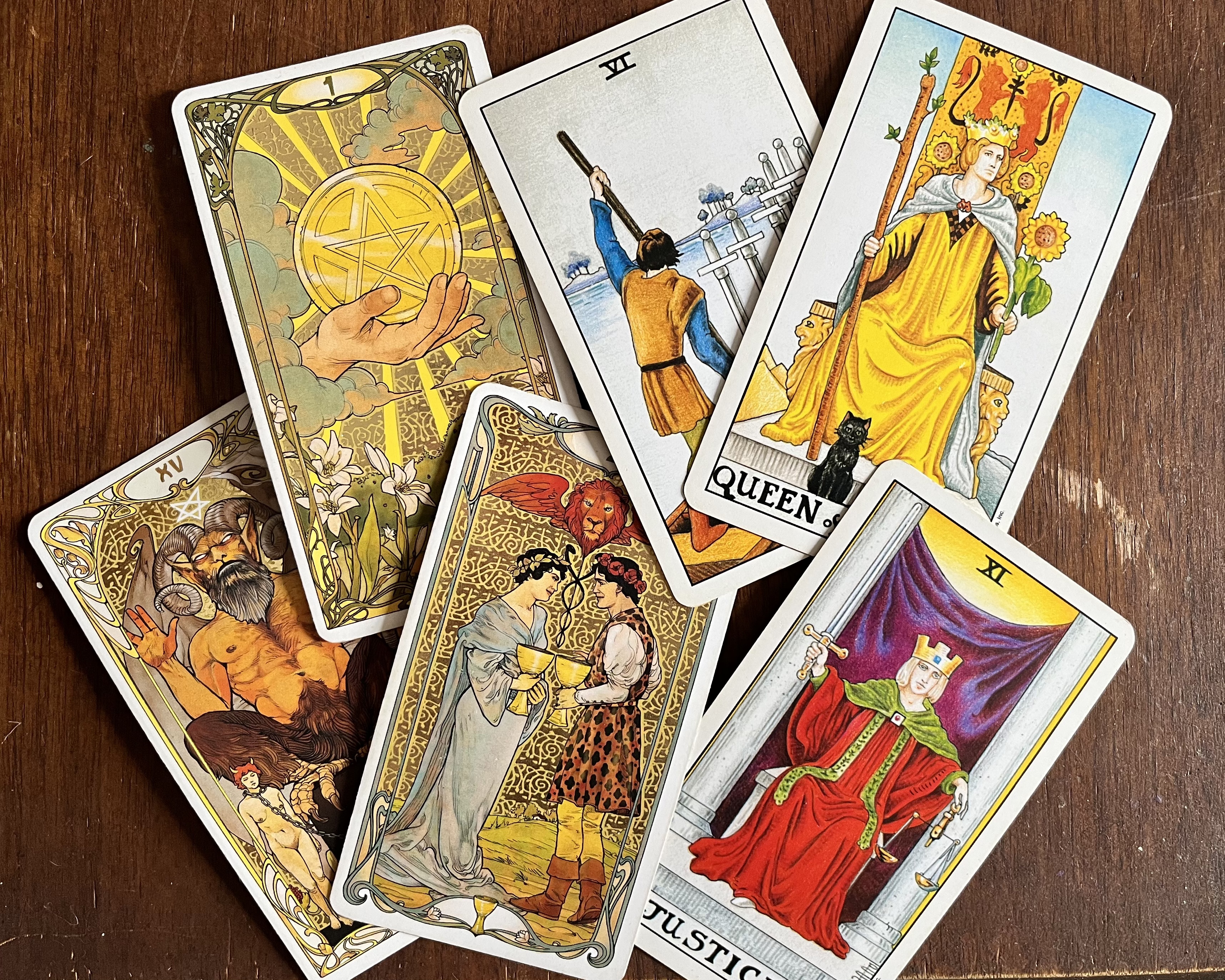
“You’re an archetypal tarot reader, awesome! . . . Sorry, but what does that mean exactly?”
I get this every time I tell someone what I do at a party, and for good reason. People know what the tarot is and basically how it’s read, but when I add terms like “archetypal”, “psycho-spiritual”, or “depth psychology”, a bit more explanation is required.
And perhaps you’ve even wondered this yourself, curious but still a little confused about what it really means to bring an archetypal lens to your readings.
The reason why I specify my approach is because archetypal tarot is—honestly—very different from the traditional way we use the cards. We’ve used tarot for divination and future-glimpsing for the past 200 years, but in the last few decades deeper ways of approaching the cards have emerged.
Archetypal tarot is one of these ways. It is based on the principles of depth psychology and the processes of the psyche, and therefore takes a much more psychological and soulful angle. Yes, we still apply many of the same keywords and spreads, but our orientation to them and the ways in which we work with them applies a level of depth, nuance, and psycho-spiritual truth that is entirely unique and incredibly potent.
Archetypal tarot is something that I’ve adapted from both my own study and the work of many tarot scholars before me, and I’ve taught this approach to thousands of students over the last several years. If you want to find that depth with the cards, I highly recommend checking out the Foundations of the Tarot Workshop starting June 9th. (Or if you’re a more advanced tarotist, you can jump right into the Archetypal Tarot School.)
But I’ve adapted my party “spiel” into the four main points that differentiate an archetypal tarot approach from a traditional one. Maybe you already think of the tarot in these terms, or maybe they constellate a totally new perspective, but I hope you are inspired to more thoughtfully consider how you use the cards and how they can guide you.
1. We ask deeper questions.
In traditional tarot, we tend to ask questions that require straightforward answers. We may ask things like “What will make him come back to me?” or “When will that promotion happen?” Our questions are specific and future-oriented, often seeking yes/no answers or measurable timelines. That’s because traditional tarot is focused on prediction and opportunity. It looks to answer the practical questions of what, where, when, and how.
However archetypal tarot is much more interested in the exploratory questions, engaging primarily the why. Rather than demand clear “answers”, it rejects answers all together, and instead seeks insights into our motivations, blocks, needs, and desires.
Always in archetypal tarot we are not focused on what will happen, but are curious about the deeper truths of the psyche.
Therefore, our questions in archetypal tarot are always open-ended. Instead of “What will make him come back?” we ask “How can I explore the deeper rift between us?” Or rather than “When will that promotion happen?” we ask “What do I most deeply want and what is preventing me from getting it?”
The more open-ended the question, the more room we have to explore ourselves, developing both our interpretive insight and our intuition.
2. We go beyond the “traditional” meanings.
There are those out there who read the cards solely intuitively, meaning whatever comes to them when they see the card is the meaning it holds, but I am a strong believer in having a set of established meanings for the cards. That’s not to say intuitive interpretation is not extremely important when we’re reading (it very much is), but I believe that the traditional meanings we ascribe to the cards give us a strong foundation to continue our interpretive wanderings.
That being said, the traditional meanings we do have are generally simplistic and objective. In archetypal tarot, we should be taking those meanings and adapt, expand, and explore them in a deeper way. We are interpreting the cards through the language of the psyche, whether by way of our cognitive functions, complexes, shadow, or archetypes.
With this lens the 4 of Swords transforms from “take a vacation” to “take time to restore your sense of discernment”, or the Sun goes from being about “optimism” to pointing to the radical joy and vitality of finally feeling a profound sense of authentic truth rise into consciousness.
Of course, developing these archetypal or psycho-spiritual interpretations comes with time, but this is also what I teach and offer my tarot students. I discuss these deeper archetypal interpretations of the cards in my Foundations of the Tarot Workshop and the Archetypal Tarot School, so definitely check those out if you’re interested.
3. It’s about individuation, not divination.
Traditionally we think of the tarot as a tool of divination (seeking outside supernatural or magical information to reveal the “right” decisions and inevitable outcomes), but in an archetypal approach we think of it as a tool of individuation (supporting the journey of illuminating your deeper, unconscious truths to live more authentically and fully).
Individuation is a term we get from Carl Jung and it means “becoming one’s own self” or the process of “‘self-realization’.” The goal of individuation is not to become a better self, but a fuller one. It’s about learning all the aspects of who we are so that we can see ourselves honestly, integrate them all into a whole being, and thus live freely and consciously.
Therefore, as a psycho-spiritual tool of individuation, the tarot provides us mirrors of truth, not answers drawn from an outer oracle. To get “answers” strips us of the opportunity to learn about who we are. We must see the cards reflecting back the archetypes and psychic realities that exist inside of us, so we can approach wholeness through the compass of our own self-knowledge.
Therefore when you read through the lens of individuation, there is no reading that doesn’t “fit” or gives bad answers. Every card is a portal to a deeper truth, a glimpse into the archetypal realm within you. We’re not “downloading” outside directives. We’re plumbing the depths for our own story.
4. The real work starts after the reading.
Most beginner readers want to pull cards and instantly “get it”, but not only is that an unrealistic expectation for a reader at any level, it prevents exploration of the reading and the opportunity to develop real insight.
In a traditional practice you might pull some cards, journal through them, and then move on, but in an archetypal approach, we take this process much (much) slower.
Our work with a reading really starts after we’ve put the cards back in our deck. Over the following hours, days, weeks, or even months, we can employ active imagination, dreamwork, shadow work, or the archetypal tarot techniques (something I talk about in my classes) to continue to explore the deeper reflections of the cards.
And this is not to exhaust ourselves (there’s no need to work on it incessantly), but to approach the cards we pull with the same seriousness as we might a dream. Because of the powerful archetypal content we meet in the dreamscape, we’ll continue to ponder and explore sometimes years after, and the same can be true for a reading.
The point is to take the symbols seriously, and be always curious what the psyche is revealing to you. There is always something to learn, a new truth to unfold. And I hope that you, like me, find that path of self-discovery endlessly wondrous and exciting.